
How Unified API Architecture Reduces Integration Complexity in Alarm Systems
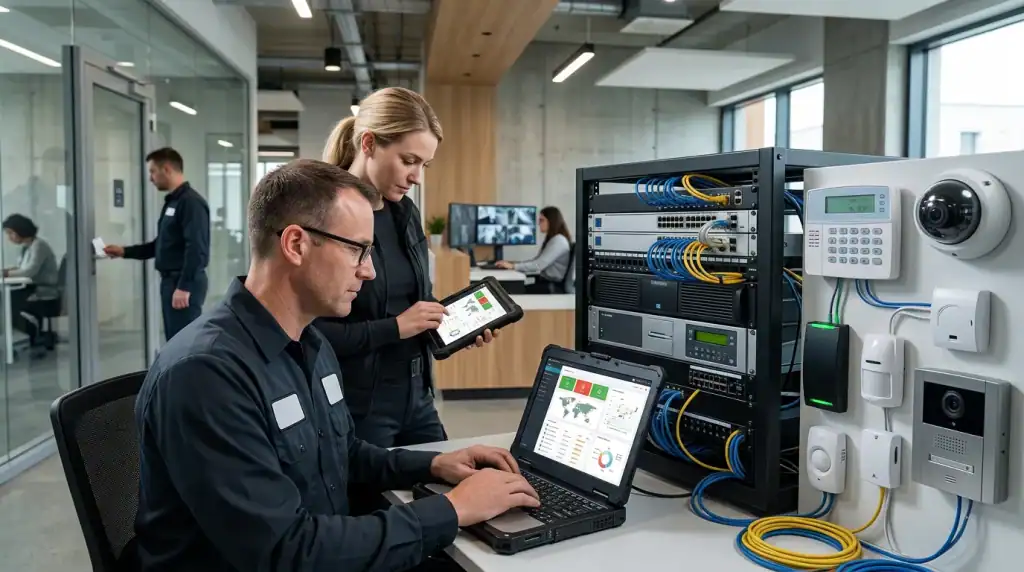
Managing an alarm business often means connecting multiple systems, from monitoring platforms and billing software to dispatch tools and customer records. When those systems don’t communicate properly, duplicate data entry, billing errors, and operational delays quickly follow.
A unified API architecture helps solve these challenges by creating a single framework for sharing information between your business systems. It reduces manual processes, improves data accuracy, and helps teams work more efficiently from a single source of information.
Let’s look at how unified API architecture simplifies alarm system integrations and supports smoother day-to-day operations.
Quick Summary
Unified API architecture reduces integration complexity in alarm systems by creating a standardized way for software, monitoring platforms, field service tools, billing systems, and connected devices to exchange information. Alarm companies can use it to eliminate duplicate data entry, improve billing accuracy, automate workflows, and manage customer, monitoring, and service operations from a single platform.
What Is Unified API Architecture?
A unified API architecture allows your alarm business systems to share information through a single connection point, reducing duplicate data entry and keeping customer records consistent across your operations.
Rather than connecting each tool you use to a separate data pipeline, every platform connects directly to a central core.
You can think of it as a common language that allows different technologies to exchange information without requiring custom communication methods for each connection.
For alarm businesses, a unified API can connect:
- CRM platforms
- Billing systems
- Scheduling and dispatch tools
- Central station fire alarm integrations
- Field service management software
What Are Common Challenges in Alarm System Integrations?
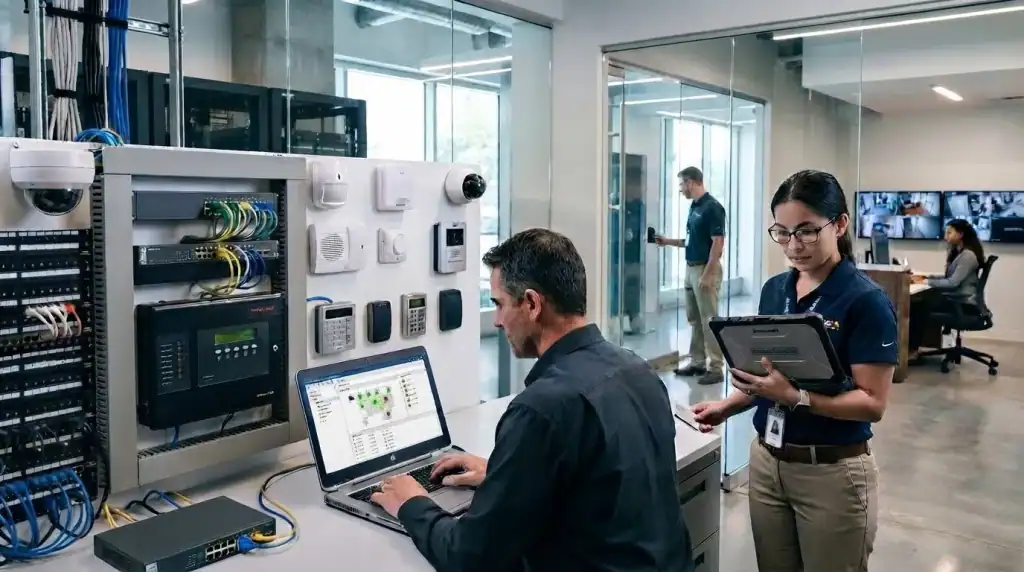
When it comes to understanding the advantages of a unified API architecture, it’s essential to know the common challenges in traditional integrations. So, let’s first take a closer look at some frequently occurring challenges in alarm system integrations.
Multiple Communication Protocols
Fire alarm hardware and software don’t use a single universal language. Instead, different manufacturers often use different communication standards, making it difficult for alarm companies to keep monitoring, billing, and customer management systems connected.
When you try to connect these systems to a standard billing platform or a basic CRM, the system struggles to communicate. As a result, you ultimately end up building individual translators for every device path, which complicates the technical infrastructure.
Vendor-Specific Platforms
Most security equipment manufacturers design closed systems. They want alarm companies to use their specific applications and cloud services exclusively.
That means if you install hardware from three different vendors, your office staff must manage three separate web portals to register accounts.
Merging these distinct manufacturer platforms into one clear operational dashboard is incredibly difficult without a central pipeline.
Data Silos
Another common challenge in standard alarm integration is data silos. It happens when your customer information lives in separate systems.
For example,
- Your sales team enters a new contract into an isolated lead tool.
- Your field technicians use a different mobile app to check physical zone layouts.
- Your accounting team manually types the same client data into accounting software.
With everything disconnected, your operations are more prone to human errors that could lead to significant record issues.
Maintenance Complexity
One more widely seen challenge in alarm system integrations is maintenance complexity. When using different software, every update breaks custom API links.
For instance, let’s say that your central station modifies its inbound signal receiver protocol. In such a situation, your custom connections may often fail without warning.
That failure often leaves your team scrambling to identify and fix broken integrations while customer accounts fall out of sync.
How Does Unified API Architecture Reduce Integration Complexity?
A unified API architecture removes the need for custom integrations, webhooks, and fragile custom scripts. By routing your business operations through one centralized data standard, you change how your staff handles data, communication, and field updates.
A unified API architecture reduces integration complexities in the following ways:
Simplifies Device Connectivity
A unified system establishes a single connection point for all incoming device data. When your technician installs a panel in the field, the activation details route through one central hub.
Also, the system automatically populates the customer CRM and prepares the centration station profile at the same time. As a result, you no longer have to register the unit on multiple manufacturer sites just to make it live.
Enables Multi-Vendor Integration
Another benefit is that a unified API normalizes the data coming from different vendors. That means your system remains efficient whether your business works with one manufacturer or several monitoring and hardware providers.
Consequently, the underlying data format looks identical inside your management dashboard. Instead of building separate workflows for each vendor, your team can manage accounts, devices, signals, and events through a consistent interface.
Creates Centralized System Management
When all your integrations run through a single architecture, managing them becomes far simpler. Instead of logging into dashboards and opening multiple sheets, you have one place to monitor, troubleshoot, and update.
The centralization also supports the single point of data entry model that operationally mature alarm companies often use. In such systems, a customer enters their information once, and it automatically flows to billing, central station monitoring, scheduling, and service history.
This approach supports a Single Point of Data Entry model, where customer information is entered once and automatically shared across billing, central station monitoring, scheduling, service history, and reporting.
Improves Automation and Smart Responses
A connected architecture makes automation much more reliable. That’s another way in which a unified API reduces the complexity of integrating alarm systems. When a monitoring event triggers an alert, the system can automatically create a service ticket, notify the appropriate technician, and update the customer’s service history.
Besides that, it also notifies a field technician and flags the account for follow-up, all without anyone manually moving information between platforms. For alarm companies managing a large subscriber base, this kind of automated workflow is truly valuable.
Reduces Development and Maintenance Costs
One of the biggest benefits of unified API architecture is that it reduces development and maintenance costs for alarm companies. When there is only one core connection, maintaining your alarm business infrastructure automatically becomes less expensive.
Whenever an external monitoring partner updates their software API, the update only affects how the central hub communicates with that specific partner. Your internal CRM, inventory trackers, and billing setups remain completely untouched and active. That saves you from emergency developer fees.
Summing It Up
For alarm companies, unified API architecture is more than a technical improvement. It helps eliminate duplicate data entry, improve billing accuracy, automate workflows, and create a Single Point of Data Entry across your business operations.
At WorkHorse SCS, we’ve created a dedicated platform specifically for the alarm industry that unifies communication between monitoring centers, software systems, and service providers through a single integration layer. As an alarm company owner, you can use it to reduce operational delays and maintain a more reliable recurring monthly revenue stream.
Schedule a free demo today and see how WorkHorse SCS helps alarm companies manage monitoring, billing, service, and customer operations from a single platform.
However, redundancy alone does not guarantee uninterrupted monitoring. Your central operations platform should also integrate seamlessly with both the primary and backup systems used by your monitoring provider. Without that operational connection, even strong redundancy can still create errors in data flow, billing accuracy, and service visibility.
WorkHorse SCS gives alarm companies a single point of data entry for customer records, service activity, scheduling, billing, and central station integrations, helping your team reduce duplicate work and keep operations easier to manage.
Frequently Asked Questions
What are the benefits of a unified API for software integration?
For alarm companies, a unified API can reduce duplicate data entry, simplify central station integrations, improve billing accuracy, and reduce the time spent managing multiple software platforms.
How to manage multiple API integrations efficiently?
The best solution is to combine them into one platform built for the alarm security industry. When you do so, your company will no longer need to manage individual software subscriptions, custom webhooks, and fragile third-party integrations.
What are the 4 layers of API architecture?
The four layers of API architecture are the interaction layer, application layer, integration layer, and data layer. These 4 layers constitute a structured blueprint that standardizes data flow between alarm devices, the central station, and internal systems.
Ready to transform your alarm business? Contact WorkHorse today for a FREE demo and consultation.
Let us help you streamline your operations and achieve greater success with our all-in-one software solution.

We are your Single Point of Data Entry